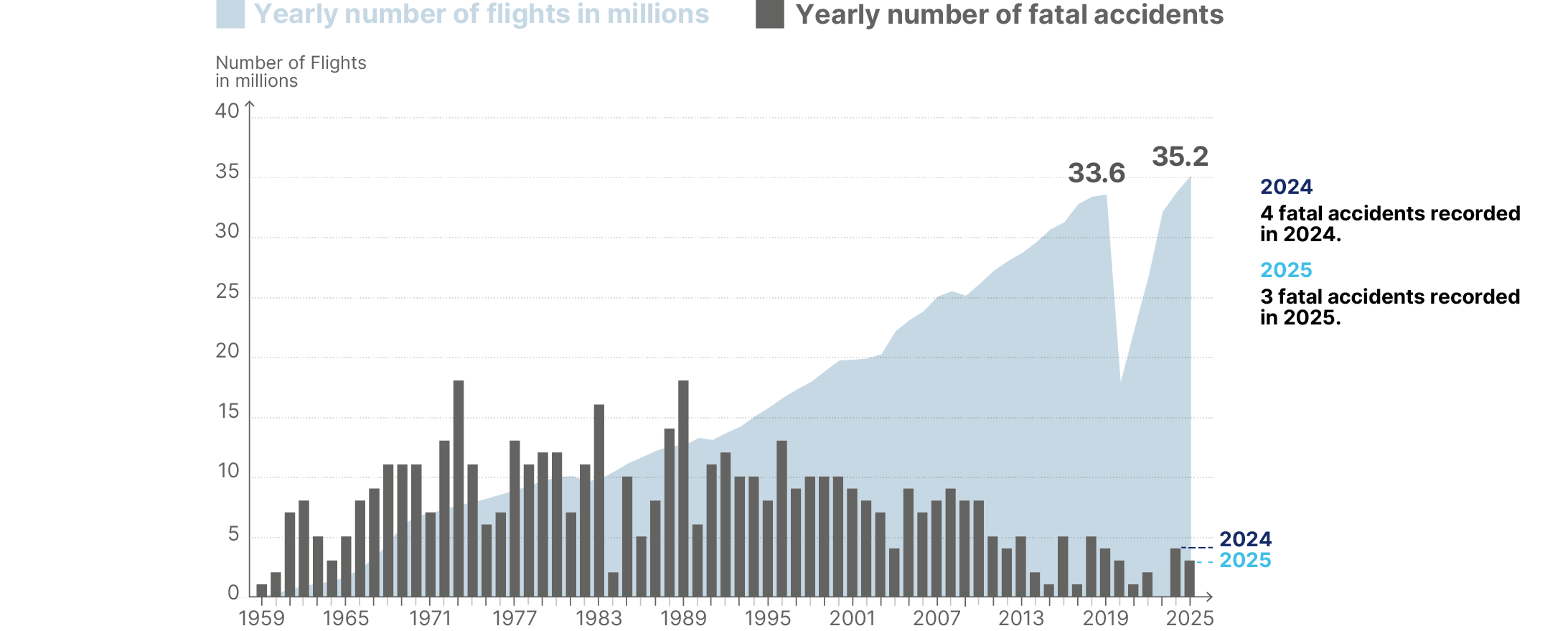
In contrast to 2024, which saw four fatal accidents and twelve hull losses, 2025 recorded three fatal accidents, all of which resulted in hull losses, alongside a further three hull losses without fatalities. The long term trend remains that the total number of accidents continues to decrease each decade.
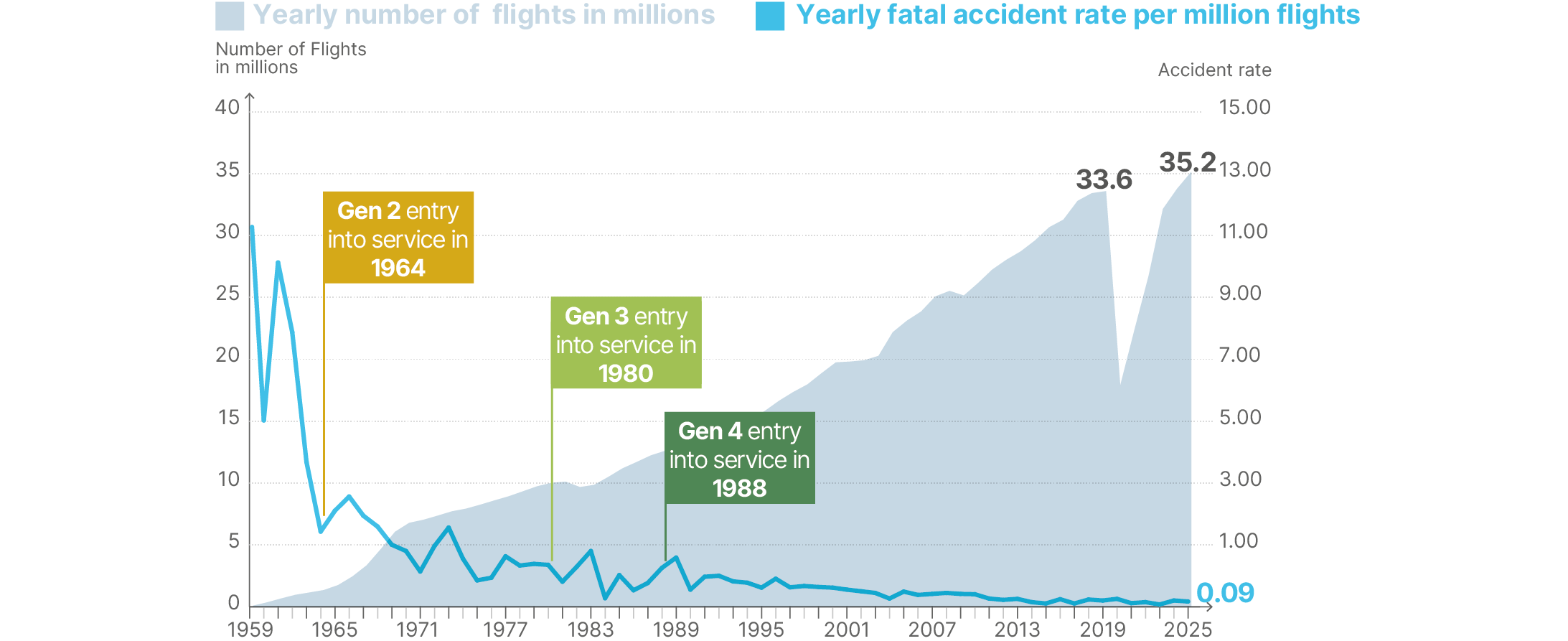
As the number of accidents and flights will vary each year, accident rates are more relevant than reviewing the number of accidents per year when analysing trends.
However the growth in air traffic is increasing. In consequence, the industry must remain vigilant, avoiding the trap of complacency.
However, safety statistics from a single year may not accurately reflect long term trends. Analysis of the fatal accident rate has shown a steady decrease over time despite the significant growth in commercial jet aviation traffic, especially in recent decades. Introduction of new technologies with the arrival of each aircraft generation, and continuous incremental enhancements, are a key enabler to reduce the fatal accident rate. More detailed information and analysis of the impact of these technologies are described in the “Generation of Jets, Accident Rates by Category & Generations” section.
Advances in technology have helped to reduce accident rates for each generation
The continual reduction in accident rates has been achieved by an ongoing commitment of the commercial aviation industry to enable a safe aircraft to be safely operated in a safe air transport system.
A notable part of this success is due to effective regulation, a strong safety culture, and improvements in training. Technological advances are also a crucial enabler for enhancing the level of safety. In particular, technologies introduced in aircraft systems intentionally evolved with improving safety as their aim.
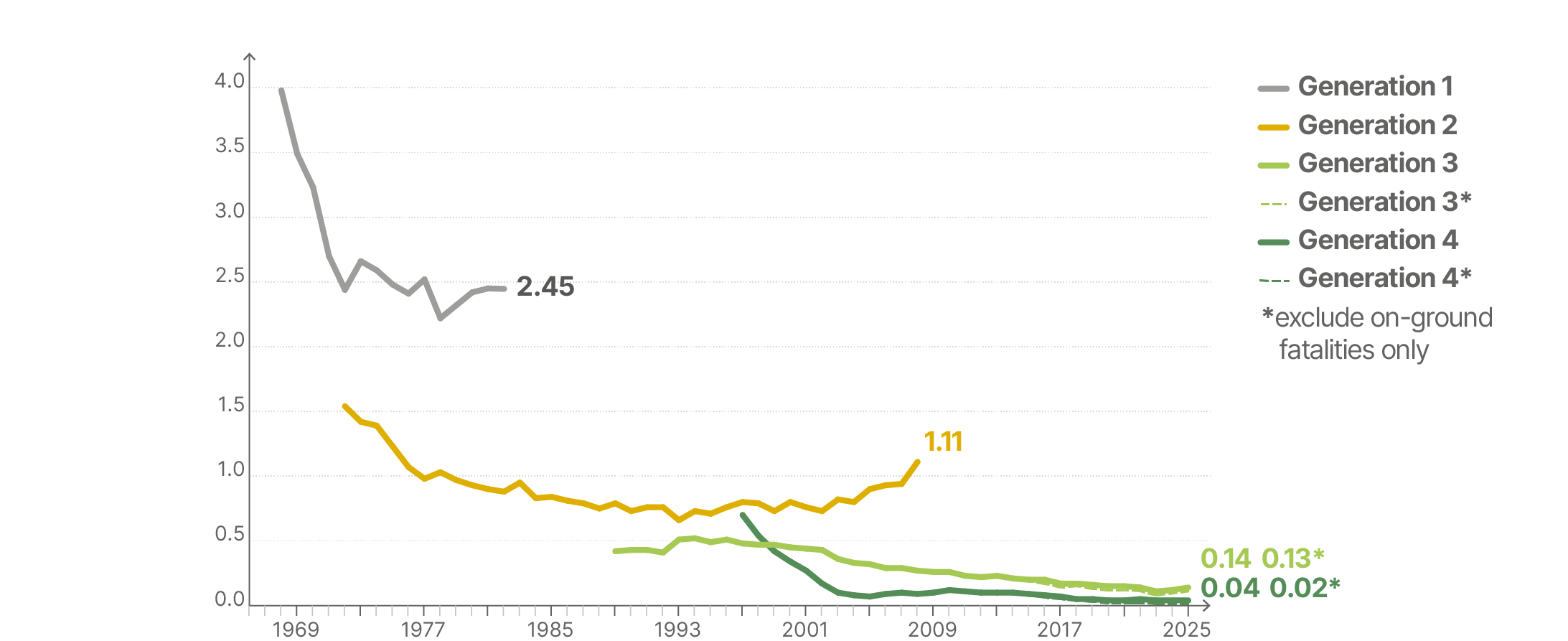
A comparison of fatal accident rates by generation of aircraft provides a clear illustration of the value of commercial aviation industry investments in technology to improve safety. Generation 4 aircraft have the lowest accident rate of all. In 2025, the generation 4 fatal accident rate was 0.04 accidents per million flight cycles. This was around 3 times lower than the rate recorded for generation 3 aircraft.
10 year moving average fatal accident rate (per million flights) per aircraft generation
No Data Found
*excludes ground fatal accidents
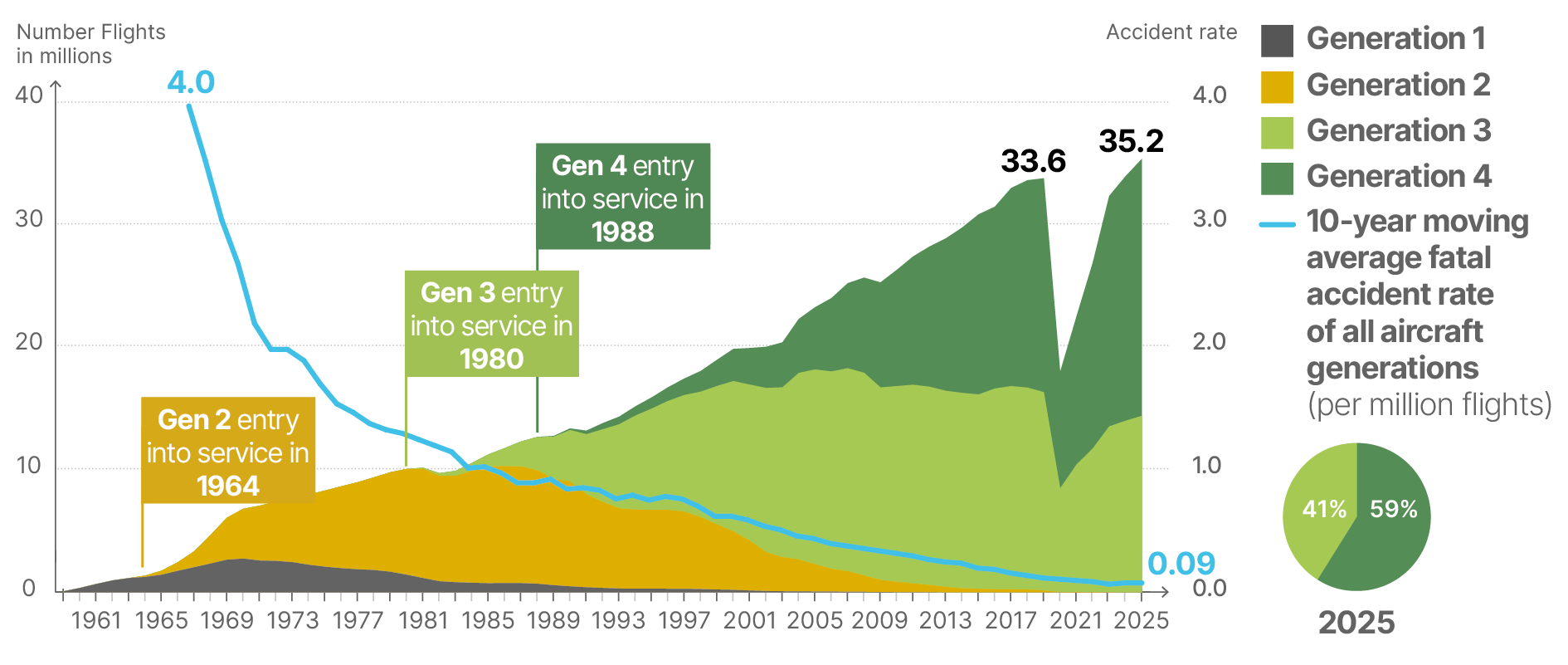
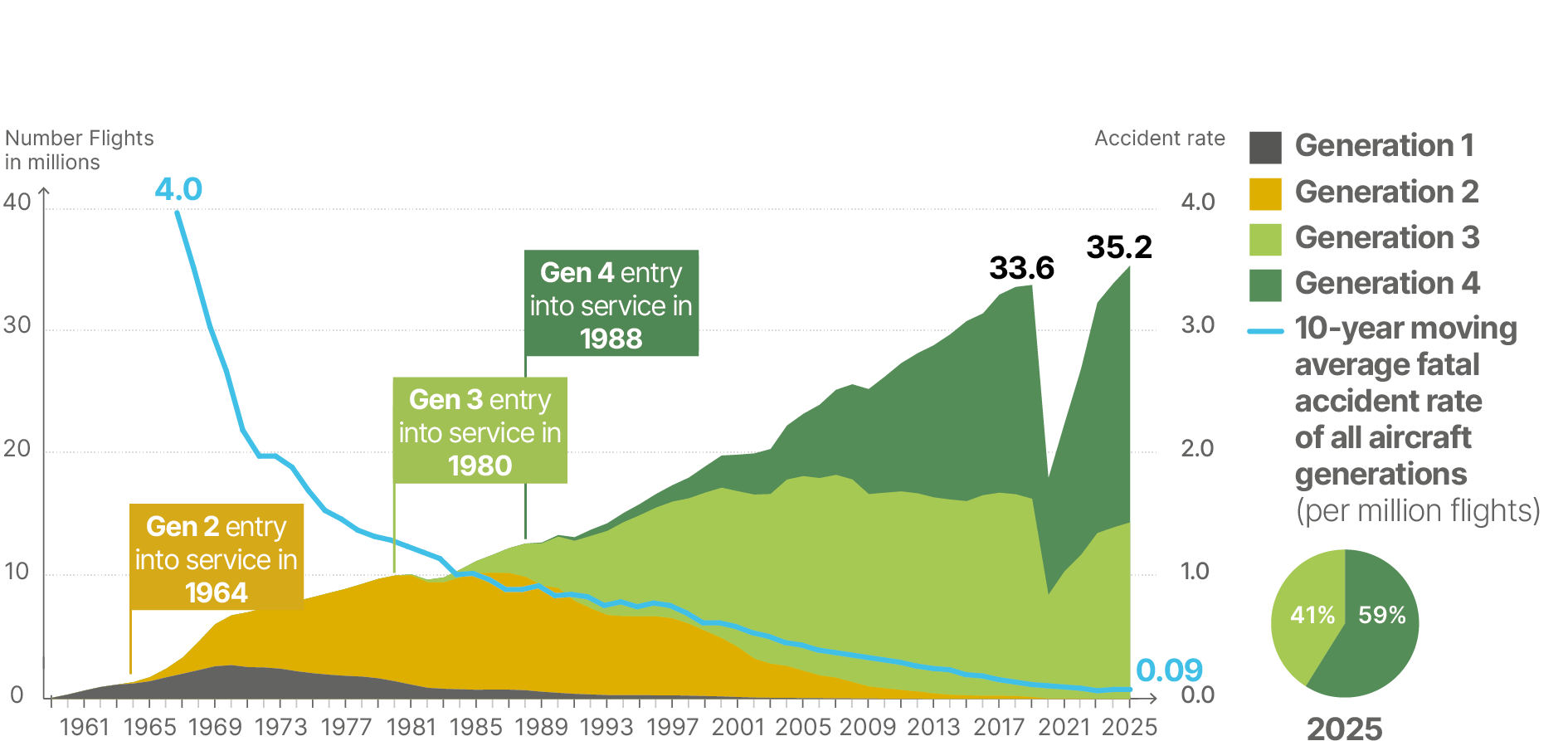
Evolution of the Fatal Accident Rate of Aircraft Generations and Air Traffic
The 10-year moving fatal average accident rate provides a clearer picture of an overall trend. A notable part of this success is due to effective regulation, a strong safety culture, and improvements in training. Technological advances are also a crucial enabler for enhancing the level of safety In particular, technologies introduced in aircraft systems intentionally evolved with improving safety as their aim.
In 2025, all aircraft generations had a combined rate of 0.09 fatal accidents per million flight cycles.
10-year moving average fatal accident rate of all aircraft generations (per million flights) and the evolution of the air traffic of each aircraft generation over the year