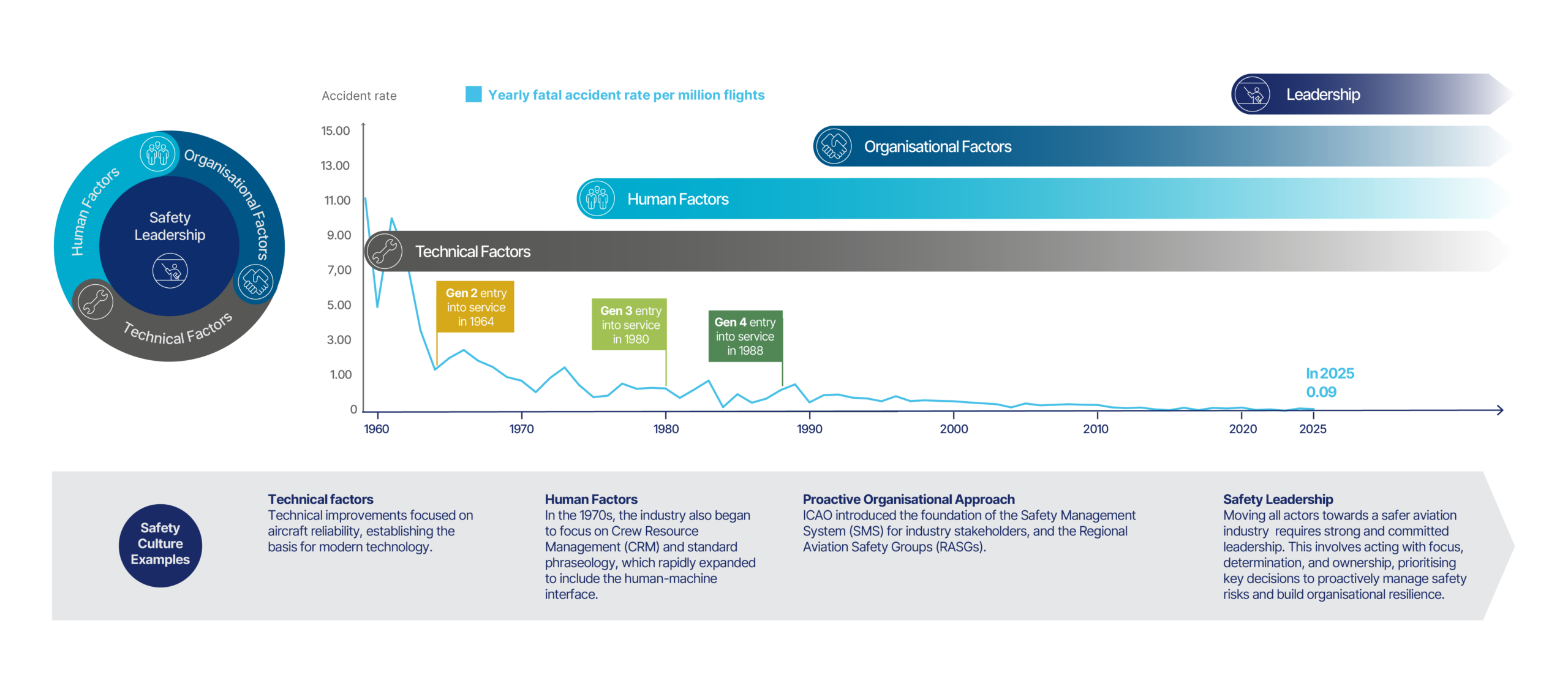
A positive safety culture is a journey of continuous improvement. While technology contributes to preventing accidents, the industry has acknowledged the need to expand its focus to human and organisational factors.
In the early days, commercial aviation established a strong legacy of technological progress by improving aircraft design (e.g., autopilot, auto-throttle systems, electronic displays, flight management systems, flight envelope protection, etc.).
By the 1970s, the industry recognised Human Factors as a critical element in accident prevention. This led to the introduction of Crew Resource Management (CRM), which became a standard practice in the 1980s.
In the 1990s, the scope of safety expanded to include organisational factors in the industry. This marked the start of the era, which views safety as a shared responsibility, not just an individual one. This philosophy was formalised through the Safety Management System (SMS), which proactively manages safety risks to build organisational resilience, allowing the system to recover, adapt, mitigate, and anticipate safety risks.
This establishes safety as a core value, not just a set of rules, driving continuous improvement throughout the organisation. The SMS relies on the organisation’s safety culture. Therefore, enhancing the safety culture is essential journey for addressing future challenges and strengthening safety at all levels of the air transport system. Safety culture requires more than just looking ahead; it relies on a strong focus on the present. The industry must prioritise the deployment of proven solutions while strictly adhering to core fundamentals.
As illustrated in the infographic below, the aviation accident rate has continuously decreased. This is driven by technological advances of each aircraft generation and a positive safety culture which encompasses technical, human factors, and organisational factors.
Moving all actors towards a safer aviation industry requires strong and committed leadership. This involves acting with focus, determination, and ownership, prioritising key decisions to proactively manage safety risks and build organisational resilience.